The Future of Driver Protection: Innovations Shaping the Next Generation of Safety Equipment
The new generation of safety gear focuses not on including additional preventive measures or increasing the toughness of the existing material. Instead, it concentrates on ensuring that proven equipment is effective for each specific driver. This transition – from general safety to tailored, precise protection – is redefining safety in motorsports.
The standard that everything else is built around
The FIA 8856-2018 regulation sets the baseline for flame-resistant clothing in professional motorsport. It increased the Heat Transfer Index requirement by 20% compared to its predecessor, ensuring drivers have a minimum of 12 seconds of protection against direct flame before second-degree burns occur. Those 12 seconds exist to give marshals and safety crews enough time to reach a car. That number isn’t abstract – it’s the difference between a driver walking away and not.
Materials like Nomex remain the keystone for suits that meet these compliance regulations. Due to it’s advanced structure, it doesn’t drip or melt when put under heat stress. This is more important than qualities like tensile strength for catastrophic accidents involving fire, which are unfortunately not an uncommon occurrence. Materials like this are now being weaved into multi layer systems that weigh less than previous versions. This helps to reduce the overall fatigue a driver suffers from bearing the weight of their gear across the race.
The anatomy problem that took too long to solve
Throughout motorsport’s history, women wore men’s suits with different labels in hope that it would fit. However, all that bunching and pulling not only made it look unprofessional, it left many open to serious injury should the worst happen. Fire-resistant materials are only that when there’s minimal-to-no room between a woman and the suit. That distracting pull at the hip when driving 80+ mph turns a fire-resistant barrier into an air vent.
The industry has started treating this as an engineering problem rather than a marketing one. Fia approved women’s race suits designed around female anatomy ensure the protective layers function as the standard intends – consistently, across the torso, shoulders, and hips where fit deviation is most common. A suit that gaps at the hip during a high-G corner isn’t offering the protection its certification assumes.
Thanks to the introduction of 3d body scanning, having a form fitted suit is much easier. Rather than basing measurements and pattern shapes off of an average male form, it’s possible to use real measurements and scans to produce suit patterns that pass compliance tests and provide a full range of benefits to all drivers.
Stretch panels and the egress argument
The stretch panels located in the underarm and lower back areas of a driver race suits were first introduced as a comfort feel for drivers during long races. However, there’s so much more to their presence than comfort.
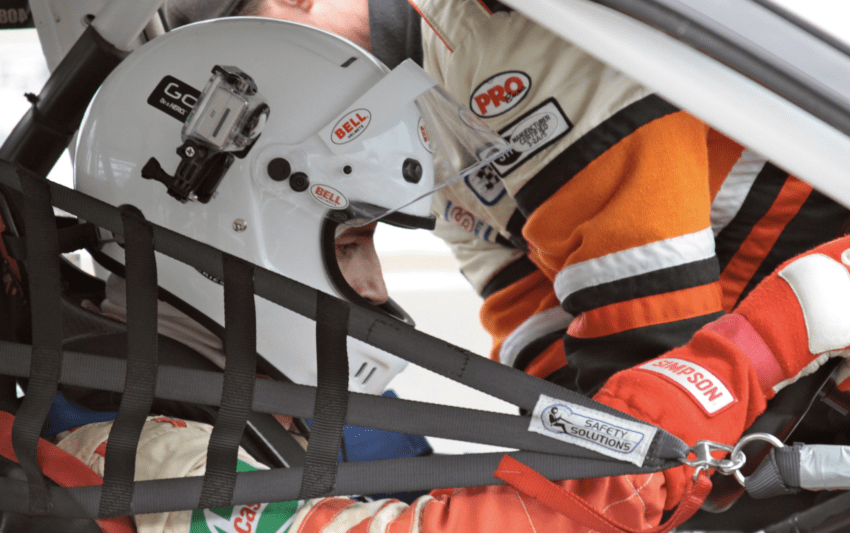
In the likely event of needing to eject from a car, a driver must be able to easily contort himself and move freely given that often, suits come under tension and create lots of stress points. This makes them a potential safety precaution rather than just bringing comfort to the driver. If your suit stretches at the back and in the underpart of your sleeves, it will not grip your harness or your seat pushing you forward as you try to exit the car.
This is the difference between a stretch panel being a comfort feature and a safety feature: it’s contextual. A comfort feature is one that enhances your performance while a safety feature saves your life. Often it can be the same thing.
Gear as a connected system
The HANS device revolutionized impact safety by considering the head and neck as a single system rather than two separate problems to solve. This concept is now extended to the entire set of equipment. The integration of biometrics has evolved from a conceptual approach to a real production solution. For example, sensors that are woven into base layers provide real-time monitoring of heart rates and core temperatures. Then, the data generated by these sensors can be transmitted to the teams during a race or practice session. In addition to moisture-wicking fabrics, which provide better thermal stress management, the role of the base layer has evolved from just a product that was nice to have into a more functional component that can improve the overall health of the driver. Thermal fatigue, for example, is a well-documented factor in late-race incidents. Gloves, suits, and helmets are designed to easily interact with each other. For example, these items have an ergonomic geometry that is shared between them. In addition to that, the material boundaries near the wrists and collars are consistent. This helps with the glove-to-suit interface and with the helmet-to-suit impact load distribution.
Materials going further
Sustainability is entering the conversation without compromising performance. Several manufacturers are now producing aramid fibers from recycled feedstock that meet the same FIA flame-resistance ratings as virgin material. The fiber’s heat resistance comes from its molecular structure, not its origin, so the safety case holds.
Lightweighting efforts are also converging with this. Thinner, stronger weaves mean less raw material per suit without reducing the Heat Transfer Index. Less material, less weight, same certification – that’s a meaningful engineering outcome, not a marketing one.
The clearest signal that motorsports safety gear is maturing isn’t a new helmet design or a better foam compound. It’s that the industry is finally asking who the gear is actually for – and engineering the answer from the ground up.